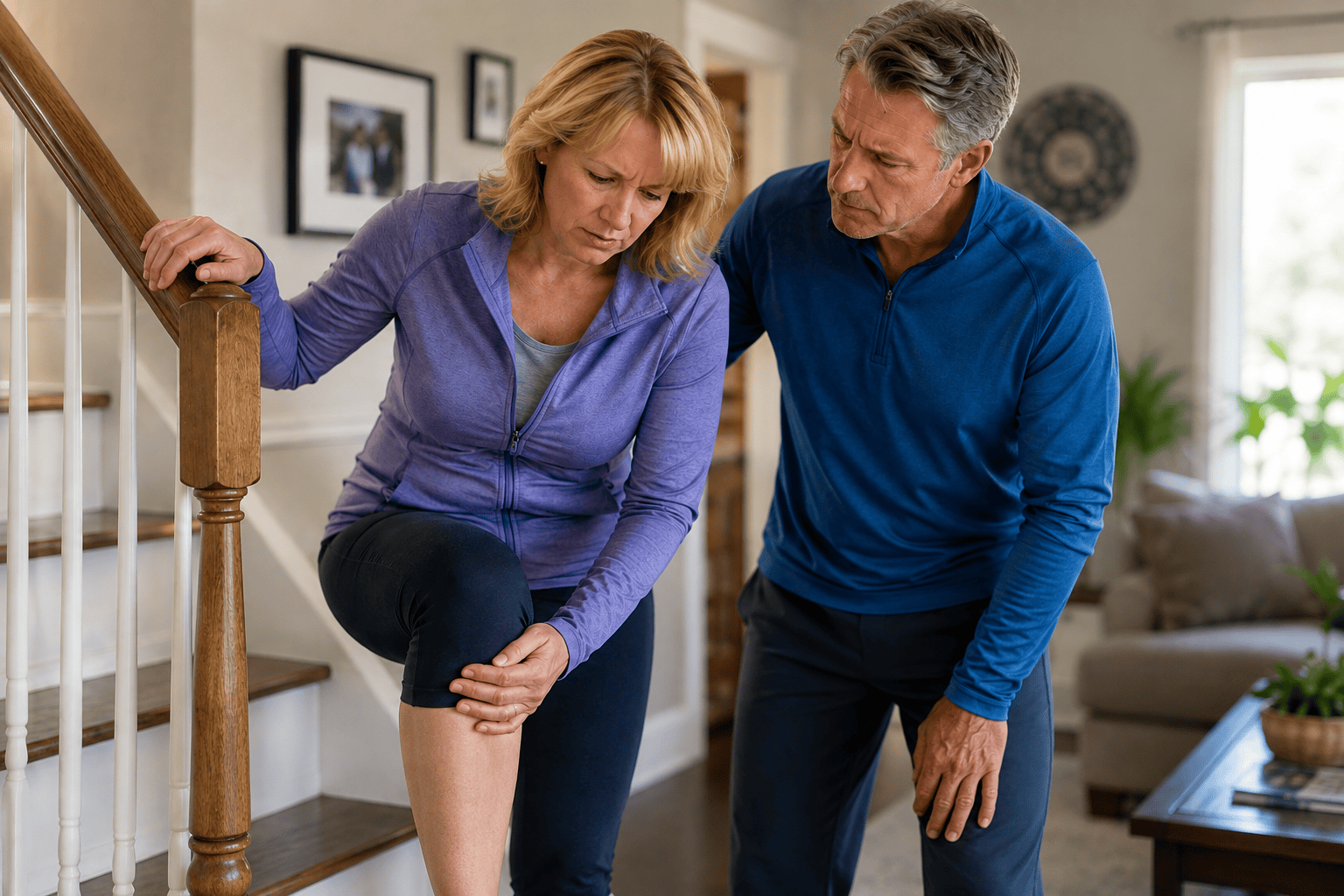
You head out for a walk feeling perfectly fine.
Ten minutes later, your knee begins to ache. By the time you finish shopping or return home, you’re looking for the nearest chair. After sitting for a few minutes, the pain starts to fade.
If that sounds familiar, you’re not alone.
One of the most common questions we hear is:
“Why does my knee hurt when I walk but feel better when I rest?”
Many people assume their knee is simply wearing out or that arthritis is to blame. While arthritis can certainly play a role, it isn’t always the full story. The way your pain develops during activity, and eases with rest, often provides important clues about what’s really happening.
Why Does Walking Hurt… But Rest Helps?
Walking places repeated demands on your body. When everything is moving well, your hips, knees, ankles, muscles, and balance work together to share that load.
If one part of the system isn’t doing its job, however, the knee often has to compensate.
That extra stress usually isn’t noticeable with the first few steps. Instead, it builds gradually over hundreds or even thousands of steps until the tissues around the knee become irritated.
Think about carrying a heavy grocery bag. It doesn’t hurt the moment you pick it up. The discomfort develops over time and eases once you set it down.
Your knee often behaves the same way.
Rest reduces the repeated stress that’s irritating the joint, which is why the pain often settles after sitting down. But while rest may calm the symptoms, it doesn’t necessarily address what’s causing them.
Walking usually isn’t the problem. More often, it’s how your body handles the repeated demands of walking.
The Pain Isn’t Always Coming From the Knee
Another common misconception is that the painful area must be the source of the problem.
Your knee sits between your hip and your ankle. If either one isn’t moving or functioning well, the knee frequently has to work harder with every step.
Sometimes the knee isn’t working alone. If the hips, ankles, or even the lower back aren’t doing their share of the work, the knee may have to compensate. That’s one reason a thorough evaluation often looks beyond the painful area instead of focusing only on the knee itself.
Your knee is part of a larger movement system, and understanding that system is often the key to understanding your pain.
Is It Arthritis?
Arthritis becomes more common as we age, so it’s understandable that many people assume it’s responsible for their knee pain.
The reality is more complicated.
Many adults have arthritic changes visible on X-rays but experience little or no pain. Others have relatively mild changes yet struggle with everyday activities.
That’s because pain is influenced by more than the condition of the joint itself. Strength, flexibility, previous injuries, inflammation, and movement patterns all affect how your knee responds to daily activity.
Rather than focusing on an image alone, it’s often more helpful to understand how your knee functions during the activities that cause your symptoms.
Even when arthritis is present, it doesn’t automatically mean it’s the only reason your knee hurts or that surgery is your only option.
The amount of pain you feel doesn’t always match what an X-ray shows.
The Good News
One of the biggest myths about knee pain is that it automatically means your joint is “worn out” and there’s nothing you can do.
Fortunately, that’s often not true.
While age-related changes inside the knee are common, pain isn’t always caused by those changes alone. In many cases, improving strength, mobility, balance, and walking mechanics can reduce unnecessary stress on the knee and make everyday activities more comfortable.
The first step isn’t finding the perfect exercise, it’s understanding why your knee hurts in the first place. Once you identify what’s contributing to your symptoms, you can make more informed decisions about how to move forward.
Knee pain while walking doesn’t automatically mean you’ll have to give up the activities you enjoy.
What Should You Do Next?
If walking makes your knee hurt, it’s natural to think the answer is to stop walking.
While reducing activity may provide temporary relief, avoiding movement for long periods often leads to weaker muscles, stiffer joints, and less confidence in everyday activities.
A better long-term approach is to identify what’s placing extra stress on your knee and address those contributing factors. For many people, that means improving strength, balance, mobility, and movement quality rather than simply treating the painful area.
Because everyone’s body is different, there isn’t a single exercise or treatment that’s right for everyone. The best approach is one that’s tailored to the underlying cause of your symptoms.
The goal usually isn’t to stop moving, it’s to move more comfortably and confidently.
When Should You Seek Professional Advice?
It’s normal to feel sore after an unusually active day.
However, if your knee pain lasts for several weeks, keeps returning, limits how far you can walk, or causes you to avoid activities you enjoy, it’s worth finding out why.
Understanding the cause of your symptoms early can help you make informed decisions and may prevent months of frustration from simply hoping the pain will disappear on its own.
Persistent pain deserves an explanation, not just more time.
The Bottom Line
If your knee hurts when you walk but feels better after you rest, don’t assume it’s simply part of getting older or that your knee is permanently damaged.
Pain is your body’s way of telling you that something needs attention, but it doesn’t always identify the true source of the problem. Sometimes the issue is within the knee itself. Other times, it begins with how your hips, ankles, muscles, or walking mechanics are working together. Understanding that difference is often the first step toward finding a solution.
Whether your goal is walking the neighborhood with your spouse, keeping up with your grandchildren, exploring a new city on vacation, or simply making it through the grocery store without knee pain, identifying what’s contributing to your symptoms gives you the best opportunity to stay active and keep doing the things you enjoy.
If you’re wondering what’s causing your knee pain, our FREE Discovery Visit gives you the opportunity to discuss your symptoms, ask questions, and learn whether physical therapy may be an appropriate next step. You’ll leave with a better understanding of your situation and the information you need to decide what makes the most sense for you, without pressure or obligation.
Our goal isn’t simply to help your knee feel better, it’s to help you get back to living the life your knee has been keeping you from enjoying.