
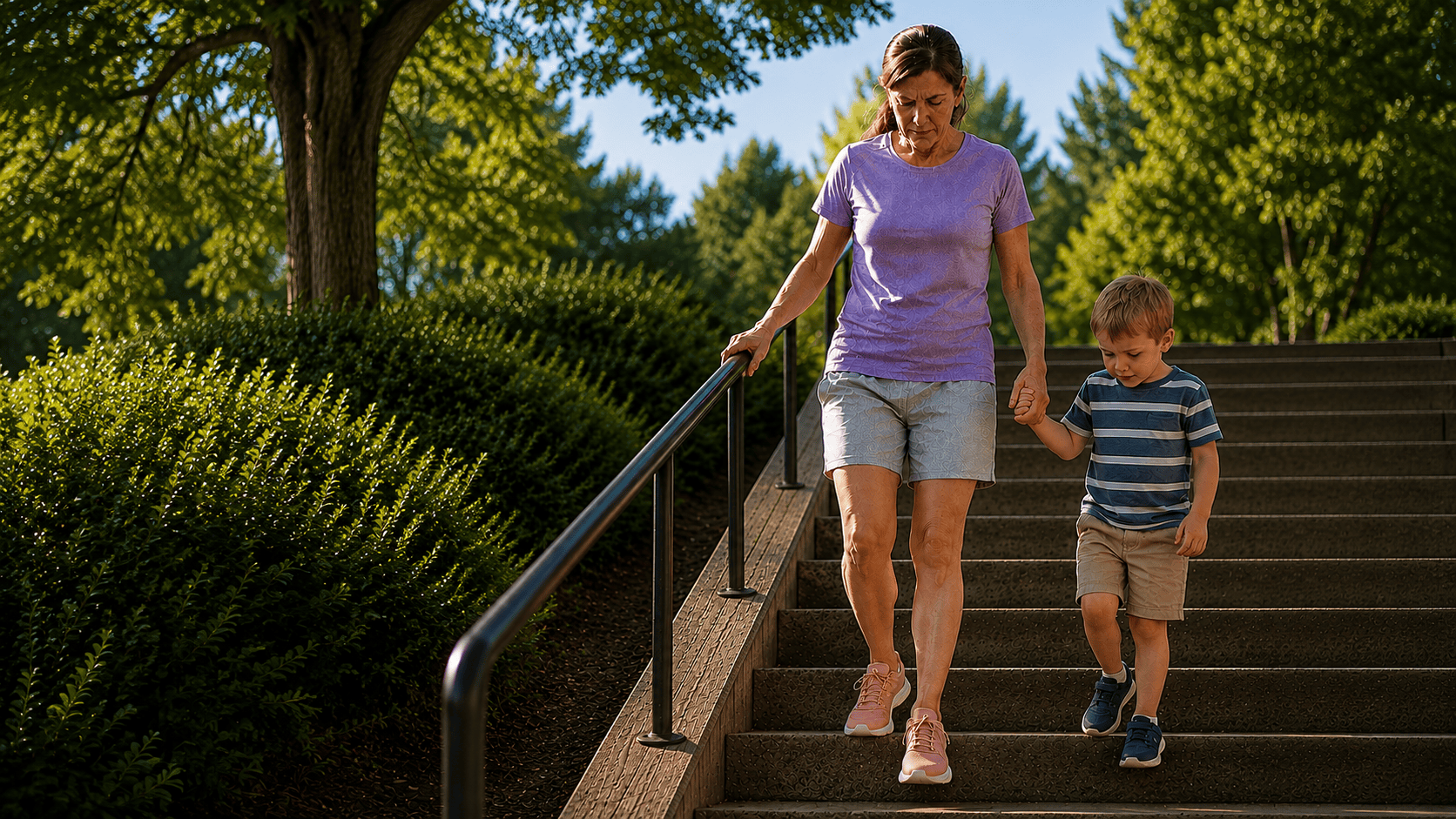
Why Does Going Down Stairs Hurt More Than Going Up?
Then you turn around to come back down, and your knee suddenly hurts.
That difference can be confusing. You are using the same staircase and the same knee, so why should the direction matter?
The answer is that going down is not simply going up in reverse. Your muscles and joints have a different job to perform.
Instead of lifting your body against gravity, your leg must control your weight while gravity pulls you toward the next step.
Going downstairs often hurts more because your knee must slow and control your body as you lower yourself.
Your Leg Is Acting Like a Brake
When you climb stairs, your leg muscles produce force to push your body upward.
When you go down, those muscles remain active while gradually allowing your knee to bend. Your thigh muscles are essentially working like brakes. They prevent you from dropping suddenly onto the next step.
The quadriceps, which are the large muscles on the front of your thigh, play a major role in this controlled lowering.
If your leg cannot manage the movement smoothly, you may:
- Drop quickly onto the next step.
- Turn your body sideways.
- Grip the railing tightly.
- Keep the painful knee stiff.
- Let the other leg do most of the work.
These adjustments may reduce discomfort temporarily. They can also indicate that your body is trying to avoid a movement it no longer controls comfortably.
Descending stairs requires controlled lowering, not simply strong legs.
Why the Front of the Knee May Hurt
As your knee bends, your kneecap moves within a groove at the end of your thigh bone. This area is called the patellofemoral joint.
The quadriceps pull through the kneecap while the knee is bent. This creates considerably more pressure around the kneecap than ordinary level walking. Research has found that stair use can place several times a person’s body weight through the patellofemoral joint. Pain around or behind the kneecap is also commonly reported during stair descent. (Hospital for Special Surgery)
That does not automatically mean the joint is damaged.
Pain can occur when the demand placed on a joint exceeds what it is currently prepared to handle. Your knee may be able to tolerate normal walking but become sensitive when asked to control your body on a step.
Symptoms may begin after:
- Increasing your walking distance.
- Adding hills or stairs to your routine.
- Returning to exercise.
- Becoming less active for a period.
- Repeating more stairs than usual.
The staircase may simply be the first activity demanding enough to reveal the problem.
Pain on stairs may reflect a difference between what the task requires and what your knee currently tolerates.
Why Going Down Requires More Control
Strength matters, but stair descent also depends on balance, coordination, and timing.
Your body must keep your pelvis steady, guide your knee over your foot, control how quickly the knee bends, and place the opposite foot accurately on the next step.
Small changes in this sequence can affect where pressure is felt.
One person may allow the knee to move inward. Another may keep the leg stiff and land heavily. Someone else may lean backward, rotate the body, or rush through the movement to spend less time on the painful leg.
These patterns are not always the original cause of pain. Sometimes they develop after the knee becomes sensitive. Either way, they can make stair descent less efficient and more uncomfortable.
This is also why two people with similar symptoms may need different solutions.
The painful moment often happens when the knee must control movement, not when it merely supports your weight.
Does This Mean Your Thigh Muscles Are Weak?
Possibly, but weakness is not the only explanation.
Someone can have strong legs and still struggle with a slow, controlled step-down. Pain may make the quadriceps less confident or less responsive during the movement.
Other possible influences include:
- Limited knee motion.
- Reduced balance.
- Fatigue.
- Fear of falling.
- Changes in movement technique.
- Difficulty controlling the leg at a certain knee angle.
The hip, ankle, and foot may also influence how the leg lines up during stair descent. As discussed in the previous article, where pain is felt is not always where the entire problem begins.
However, those areas should not be blamed automatically. A proper evaluation should determine which factors actually matter in your situation.
A painful step-down provides a movement clue, not a complete diagnosis.
Why Going Up May Feel Easier
Going upstairs still requires considerable effort. Some measures of knee loading may even be as high or higher during ascent. Yet many people experience more pain going down because lowering requires finer control through the range where the knee is most sensitive. (PubMed)
You may also have more ways to compensate while climbing.
You can lean forward, push harder through the stronger leg, use momentum, or pull on the railing. During descent, gravity is already moving you toward the next step. Your leg has less room for error.
Pain is not determined by force alone. It is also affected by movement speed, muscle control, joint sensitivity, confidence, fatigue, and your body’s current ability to tolerate the activity.
Going down may feel worse because it demands more precise control at the knee’s most sensitive position.
The Good News
Knee pain going down stairs does not necessarily mean you need to avoid stairs permanently.
In many cases, stair descent becomes more comfortable when the body gradually improves its ability to control the lowering movement.
A physical therapist may assess:
- How you descend a step.
- How far your knee bends.
- How your leg lines up.
- Your strength and balance.
- Whether your hip, ankle, or foot affects the movement.
- How much activity your knee currently tolerates.
Treatment should then be matched to what the evaluation finds. It may include gradually strengthening the leg, practicing controlled lowering, temporarily adjusting activity, and improving the movement pattern that is increasing stress on the knee. Physical therapy recommendations emphasize individualized exercise and movement training rather than assuming one exercise works for everyone.
For now, use the railing when needed, move at a comfortable pace, and avoid repeatedly forcing through sharp or worsening pain.
The goal is not merely to tolerate stairs. It is to restore the control that makes stairs feel normal again.
When Should You Have It Evaluated?
Consider having your knee evaluated if the pain is worsening, changing how you use stairs, limiting your daily activities, or continuing despite reasonable adjustments.
Seek medical attention sooner if your knee became painful after a major injury, cannot support your weight, is significantly swollen, locks in place, repeatedly gives way, appears deformed, or becomes hot and red with a fever.
For ongoing knee pain going down stairs, an evaluation can help identify what happens during the lowering phase rather than treating the painful area based on assumptions.
At our clinic, we examine the knee and the rest of the movement system. We then develop a personalized plan based on what your body actually needs.
If going downstairs has become something you dread or avoid, a FREE Discovery Visit can help you understand what may be contributing and what your next step should be.